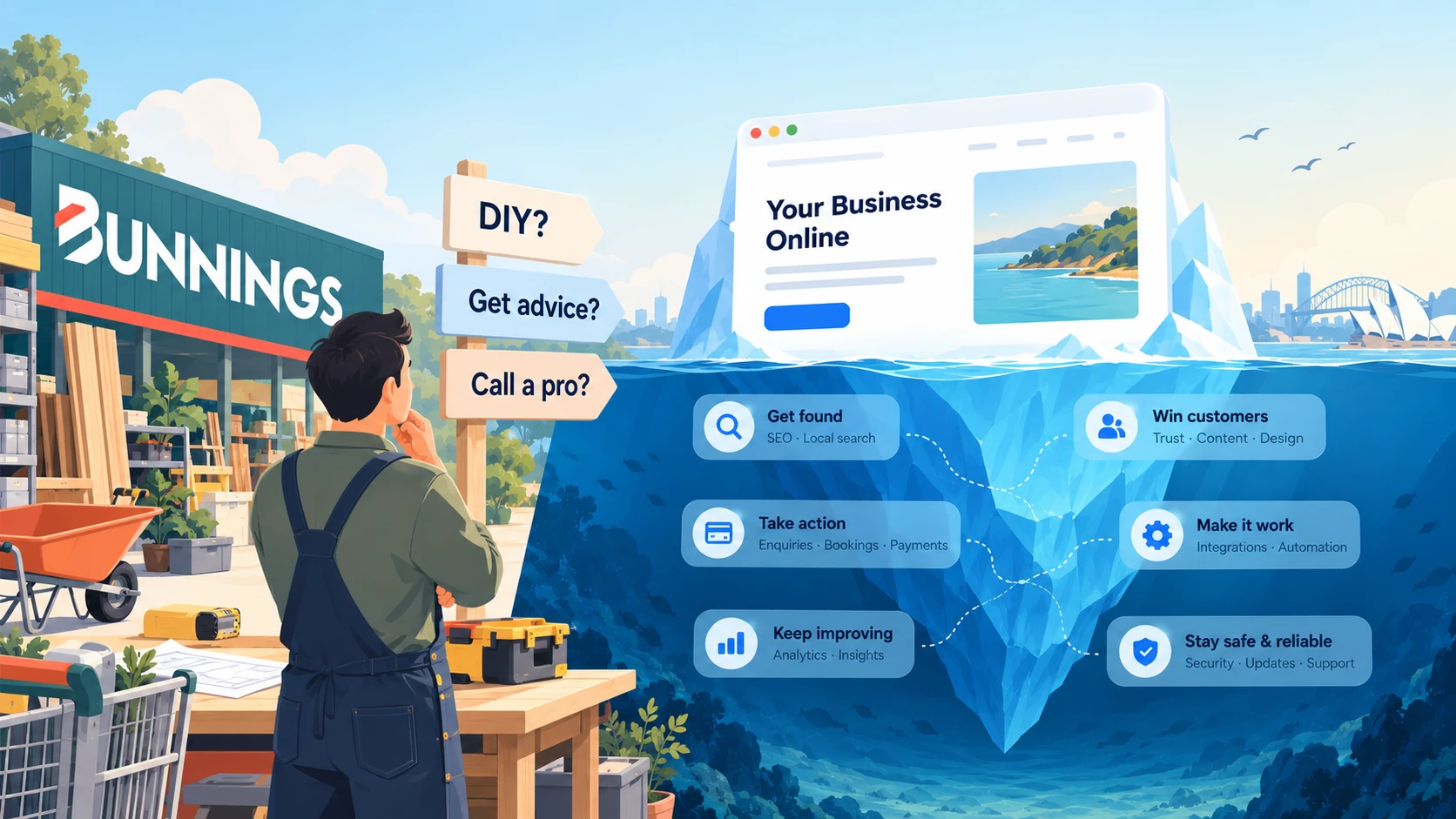
Walk into Bunnings on a Saturday and you’ll find just about everything you need for your next home improvement project.
Need instructions? There’s probably a YouTube tutorial showing you exactly what to do.
You can learn to paint a room, install shelves or tackle a garden makeover. Professional tools and practical knowledge have never been more accessible.
Yet builders, architects and skilled tradespeople are still very much in demand.
You might happily spend a weekend repainting the spare bedroom. But when a renovation involves structural changes, significant expense or work that needs specialist expertise, getting professional help makes sense.
Being able to do something yourself doesn’t always mean you should.
Building a website is much the same.
AI is becoming the Bunnings of website building
Not long ago, creating a website meant learning to code, understanding hosting and spending hours working with design tools.
Today, you can describe your idea to ChatGPT and have it help build the website for you. Tools such as ChatGPT Sites can even help you preview and publish interactive websites.
That’s genuinely useful.
A freelancer can create their own portfolio. A local club can publish its activities. A small shop can put its opening hours, location and services online without a large budget.
Many of these projects are perfectly reasonable DIY jobs.
And AI can do much more than make attractive pages. It can assist with writing, code, search optimisation, testing and business integrations.
There’s no reason to pretend otherwise.
But buying the right tools from Bunnings doesn’t automatically tell you which wall to remove, what to repair first or whether a particular solution will last.
The tools help you do the work. Someone still needs to understand the problem, choose an approach and check the result.
That matters even more when your business depends on the outcome.
A beautiful website is only the tip of the iceberg
Imagine you run a local service business.
Your new website looks fantastic. The photography is appealing, the animations are smooth, and everyone you show it to loves the design.
But customers searching for your services can’t find it.
Those who do visit struggle to understand what makes your business different. Some abandon the enquiry form. Others submit a request that never reaches the right person.
The website looks finished. Your customer journey isn’t.
Think of a beautifully renovated home. The paint, furniture and fittings create the first impression. But much of what makes the home comfortable and dependable sits behind the walls.
Websites have their own version of this hidden work.
Above the waterline: what people see.
Layout, colour, typography, photography, movement and first impressions.
These things matter. Good design helps visitors understand your business and feel confident using your site.
Below the waterline: what helps the business work.
Discovery. Can customers find your business through search and local listings? Can search engines understand your services and locations? Google’s SEO Starter Guide explains the foundations of making useful content accessible to search.
Trust. Do visitors understand what you offer, who it’s for and why they should choose you? Are the information, examples and claims accurate?
Conversion. Can customers easily enquire, book or pay? Does the journey work properly on a phone?
Operations. Do bookings reach the calendar? Are payments and orders recorded correctly? How are customer information, updates and technical problems handled?
Improvement. Can you understand how people use the site, spot problems and decide what is worth changing?
AI can assist with every one of these areas.
But a real business needs someone to decide what matters, verify that the work is reliable and take responsibility for the outcome.
A website that looks complete and a website that supports a business are two different standards of delivery.
When does DIY make sense?
Just as with home improvement, the sensible choice depends on the project.
Simple projects: give AI a go
Need a personal portfolio, an event page or a straightforward website with basic business information?
AI may be all you need.
If your requirements are clear, you can check the content and you’re comfortable maintaining the result, doing it yourself can be a smart use of your budget.
Moderate projects: DIY, then get a professional opinion
Perhaps you’ve built a website for your beauty salon.
It looks good and includes your services. But you’re unsure whether local customers can discover it, whether the booking process works smoothly or whether you’ve missed something important on mobile.
You may not need a complete rebuild.
A focused website review could identify a few practical improvements worth making.
Sometimes the most valuable professional advice is simply: “This part is already good. Keep it.”
Business-critical projects: invest in experience
Things change when your website becomes an important source of enquiries, appointments, orders or revenue.
A missed booking may mean a missed customer. A payment error creates work for your team. Poor handling of customer information can create much bigger problems.
These projects deserve careful planning, testing and ongoing support.
Even a technically simple website can justify expert input if the business relies heavily on it.
The deciding factors are not just technical complexity. Consider the business impact, the consequences of failure and how much time you’re willing to invest yourself.
Professional web agencies need to earn their place, too
AI has raised the bar for our industry.
If an agency’s only contribution is assembling a few attractive pages, customers have every reason to consider doing that work themselves.
A professional partner should bring more to the table.
That means understanding how your business attracts customers, identifying friction in the customer journey, choosing sensible solutions and explaining the trade-offs.
It also means thinking about reliability, accessibility, security, maintenance and what happens after launch.
None of this requires every website to become an expensive, complicated project.
Good judgment often means doing less, but doing the important things well.
And agencies should be using AI themselves. When technology makes routine work faster, clients should benefit from more attention to the problems that actually matter.
Before you build, ask one question
If your website looked better tomorrow, what would actually improve in your business?
Would more local customers discover you?
Would more visitors feel confident enough to enquire?
Would booking and payment become easier?
Would your team spend less time on repetitive work?
If you’re not sure, you may not need to start designing just yet.
Start with the result you want. Then decide which tools, skills and support will help you get there.
How we approach this at Coco
Coco is an independent software studio based in Hornsby, Sydney.
We use AI. We also believe it should make good websites and software more accessible to small businesses.
We’re happy to work with a website you’ve already built yourself, including one created with AI.
What interests us is whether it’s doing what your business needs.
Sometimes the answer is a straightforward website. Sometimes it’s improving a few key pages or fixing a booking journey. Other times, the real opportunity involves connecting payments, orders or customer systems.
We start by understanding your business, then help you decide what’s worth building, what you can handle yourself and what doesn’t need changing.
Already built your website with AI?
Talk to Coco about what could work better.
You might not need to rebuild anything. A little experienced guidance can make the work you’ve already done much more useful.